What a time to be alive…

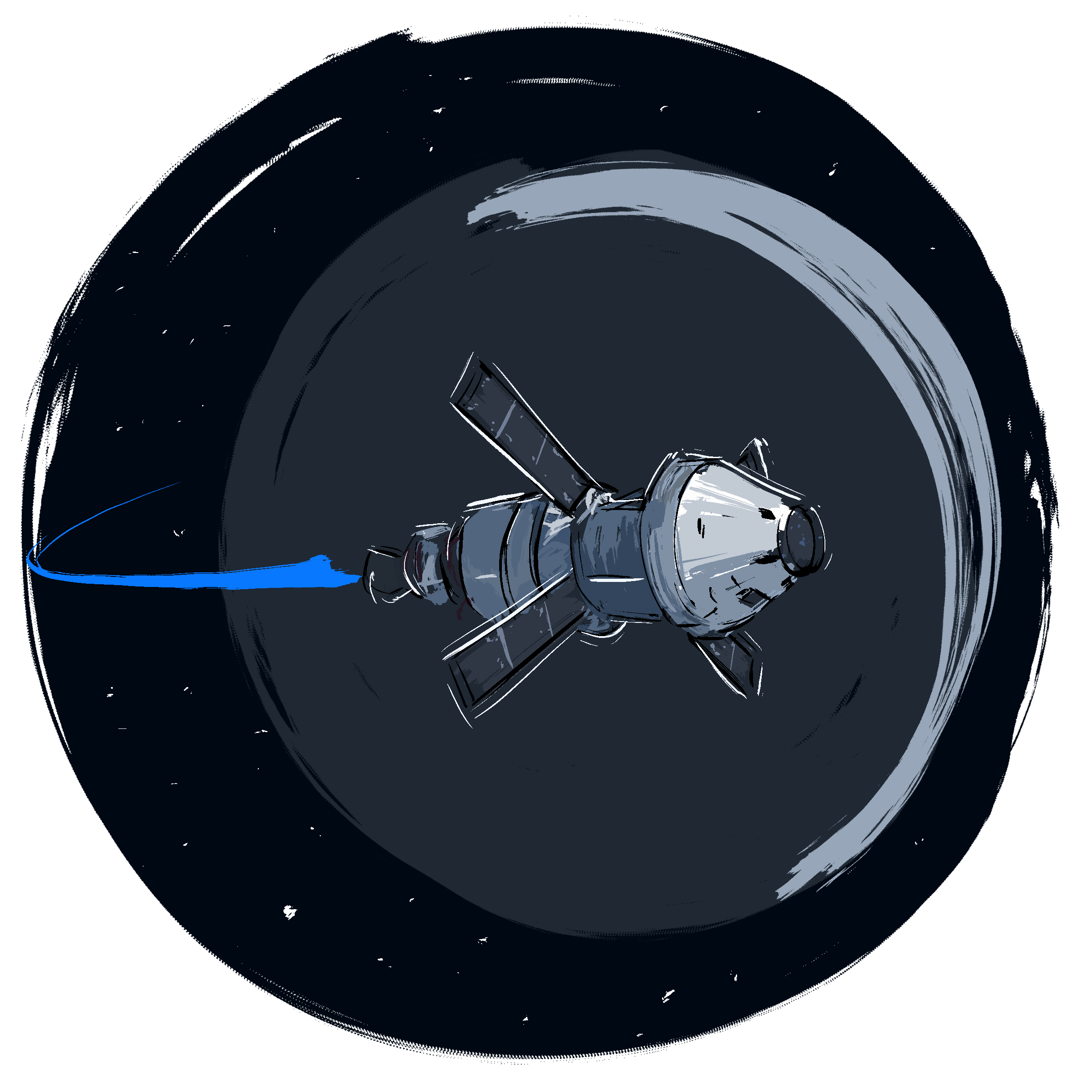
Watching Artemis II sail toward the sky, my mind echoes with memories: my dad, recounting the story of how he saw the 1969 Apollo 11 landing from his university common room TV in Dhaka—to memories of my childhood bedroom, where I’d play with this tiny model of the Discovery Space Shuttle, to more recent memories of seeing Saturn’s rings up close through the multi-million dollar telescopes at Lowell Observatory in Sedona just over a year ago. Between these dots, lines through all my middle, high school, and college science classes resonate, drumming up memories of lab work and the electric joy of learning something new.
Fitting, that I was in the middle of, and am now through, my reading of Neil deGrasse Tyson’s Starry Messenger: Cosmic Perspectives on Civilization, which was as much an overdue calibration of my inner child’s scientific wonder as it was hilarious, enlightening, and heartening. It’s a book that asks us to step outside our egos and look at civilization through the cosmic lens—not to make us feel small, but to ask us to think big.
Takeaways for the Everyday
How do we navigate a world that feels increasingly fractured? Tyson suggests taking a page from the scientist’s playbook. Handbook? Lab notebook? Field guide.
1. The Art of Disagreement
In the lab, a disagreement isn’t a duel; it’s a search for hidden variables. Tyson points out that when scientists clash, it’s rarely about who’s right and who’s wrong. Oftentimes, both sides are right, unknowingly describing different features of the same phenomenon.
Think of the blind men and the elephant: one feels the trunk and says it’s a snake; the other feels the leg and says it’s a tree. Science is the process of stepping back until the whole elephant is in view. The takeaway? Next time you’re in a debate, ask yourself: What part of the elephant am I missing?
2. The Trinity of Truth
Not all “truths” are equal. Confusing them is where the chaos starts.
- Personal Truths: the belief that the Mona Lisa is the greatest piece of art ever created, or that physical books are superior to ebooks can be true to you, deeply felt, and impossible to disprove. They give life flavor, but they don’t form the universal truths of the physical world.
- Political Truths: these are “truths” established by repetition and authority. If you say something often enough, it can become a societal “truth” regardless of validity. For example, the “truth” that climate change is an economy-damaging myth and that EPA regulations stifle American energy…compared to the objective truth that greenhouse gases and pollutants are increasingly endangering public health.
- Objective Truths: these remain true whether you believe in them or not. The chemical composition of water doesn’t care about your political affiliation. Gravity is a property of mass that works even if you’re a flat-earther. To think like a scientist is to prioritize the objective over the personal when making decisions for the collective.
3. The Clinton Method: Zooming Out
Perspective is a cure for pettiness. Tyson recounts how Bill Clinton, during high-stakes, tense meetings in the Oval Office, would occasionally point to a moon rock or look up at the sky. It was a silent reminder: whatever we are arguing about right now is happening on a “pale blue dot” suspended in a sunbeam. When the ego gets too loud, zoom out. The universe has a way of making “catastrophic” Monday mornings look like the cosmic dust they actually are.
Eye-Opening Perspectives
Tyson has a knack for flipping the script on things we think we understand. Here are my favorite mind-shift moments from the book:

- The Stationary Earth: If you stood on the near side of the Moon, you’d notice the Earth never leaves the sky. Because the Moon is tidally locked to us, the Earth would never rise or set. The visual of that perspective sticks with me.
- The Horseshoe of Ideology: We like to think our beliefs are static, but history is a comedy of errors. Tyson points out that in the 1970s, the “anti-vax” movement was largely the domain of the naturalist, left-leaning “hippies” who mistrusted “Big Pharma.” Today, that torch has been passed to the far right. It’s a reminder that our cultural battle lines are drawn in sand, not stone. Ignorance is ignorance.
- A Victory for Humanity: The book closes with a hauntingly beautiful charge from Horace Mann:
“I beseech you to treasure up in your hearts these my parting words. Be ashamed to die until you have won some victory for humanity.”
It’s a high bar, but necessary. Whether that victory is raising a kind child, solving a technical problem, or simply helping someone see the rings of Saturn for the first time, we owe it to ourselves to leave the world a little better than we found it.
Thinking back to my dad in that dorm room in Dhaka, and looking up at Orion today, the message is the same: we are a way for the cosmos to know itself. Let’s see to it that we’re worth knowing.
Thanks for reading.


Ishmam,
This is the first post of yours I have seen since I was in High School ( or maybe undergrad ). Im a grad student now. Perhaps the email notification system is funky?
It sounds like Tyson is channeling Historiography and Anthropology; not something I would’ve expected from his YouTube interviews.
Planning on reading your next post,