Module 1
Quick Reference Guide
- What is a product?
- A product is a solution
- A product is something that accomplishes a job that needs doing
- What is product management?
- Planning, creation, and improvement of products
- Oversight of the product lifecycle: Sense, Solve, Scale, Sustain
- Creator or guardian of product vision
- Interpreter and protector of the customer experience
- Guide for the technical resources to create or improve the product
- Prioritizer of the features and improvement roadmap
- Role may vary during the course of the product lifecycle; they may be Responsible, Accountable, Informed, and/or Consulted depending on need
- When talking about sustained competitive advantage, what are “flywheels?”
- Incumbent companies are remarkably resilient
- In a physical system, flywheels receive and store energy that can be tapped as needed per demand
- In a business sense, the following can be thought of as flywheels:
- Customer network
- Cost efficiency
- Product performance
- Brand equity
- Organization capability and culture
- What is the definition of product strategy?
- A dynamic formula for product rollout that considers competition, markets, resources, approaches, and how these aspects change over time
- Example of typical, successful strategy:
- Start with focused product for a high-need and high-willingness to pay customer
- Use experience to refine plan for more mainstream model
- Ride learning curve and scale to get lower price points
- Some people say PMs are CEOs of products. But when are CEOs PMs?
- A memo from Slack founder Stewart Butterfield, “We Don’t Sell Saddles Here,” Medium, Links to an external site.February 17, 2014.
- Michael Barbaro, “Jack Dorsey on Twitter’s Mistakes (42:28),” New York Times, Links to an external site.August 19, 2020, podcast.
- Takeaway: typically when an organization has a smaller product portfolio and is highly energized around innovation and launch, CEOs engage in product management. A CEOs role is more broad and managerial when the product portfolio is more expansive.
Module 2
Quick Reference Guide
- Innovation can result from push or pull
- Pull: need for news footage -> aggregator app
- Push: standing wheelchair -> Segway
- Conditions for innovation to create substantial value
- The need must be real, i.e., a significant number of customers must have a significant amount of pain
- The solutions has to actually do the job
- The organization must be able to deliver the solution at a cost significantly lower than the customer’s willingness to pay
- Pull approach is a much more reliable and repeatable way of creating value through innovation
- One of the key roles in product management is leading the creation of new products, often from nothing, sometimes called zero-to-one product development
- Clarify the job to be done
- Understand the needs of the customer
- Create a great concept or solution
- Specify the details with sufficient clarity
- Agile Development Process
- Plan
- Design
- Develop
- Test
- Deploy
- Review
- Launch
- Triple Diamond Approach to Development
- Job analysis – clarify job to be done
- Understand customer needs
- Create a great solution concept
- What is design thinking?
- Design of things we don’t normally think of as designed
- Examples
- How might we improve the process of getting ski gear on, transporting ourselves to the hill, looking at a map to determine a route down, and then finally skiing down the mountain?
- How might we improve the patient experience in an emergency department at our hospital
- How might we improve the convenience of using a bicycle for transporation?
- How might we create a delightful food delivery service?
- Designers:
- Exhibit a bias for action
- Tend to be optimists, exhibiting a culture of “yes”
- Tend to use exploratory prototypes early in the problem-solving process
- Tend to be skilled at visual expression
- Tend to use empathic methods for udnerstanding customers
- Use data-based approaches
- Identify the first group of customers you want to target, and their persona
- “Customers don’t want a quarter-inch drill. They want a quarter-inch hole.” –Theodore Levitt
- An “insight” is a user need that is authentic, non-obvious, and significant, like a professional athlete’s need to tightly control the macronutrients they ingest (food delivery example)
- Kano Diagram: Four Types of Needs
- Horizontal axis: extent to which need is satisfied by the solution (need not met at all to need fully met)
- Vertical axis: resulting change in customer satisfaction, perceived value (intense dissatisfaction to delighted)
- Latent needs – if unaddressed are not missed but if addressed result in surprise and delight
- Don’t care needs – irrelevant to customer
- Linear needs – needs where customer satisfaction is directly proportional to extent to which solution addresses need, e.g. affordability
- Must haves – needs that if fully addressed do not result in dramatic improvements and satisfaction, but if not addressed at all will result in extreme dissatisfaction
- How to identify customer needs
- Get out of the office and interact
- Conduct 10 one-on-one interviews
- Record
- Interview the customers in use environment
- “How do you currently do the job?”
- “What would be your perfect X experience?”
- “What annoys you most about x?”
- Ask them to show, not tell
- Create “open doors” and walk through them; try to identify pain points and needs
Module 3
Quick Reference Guide
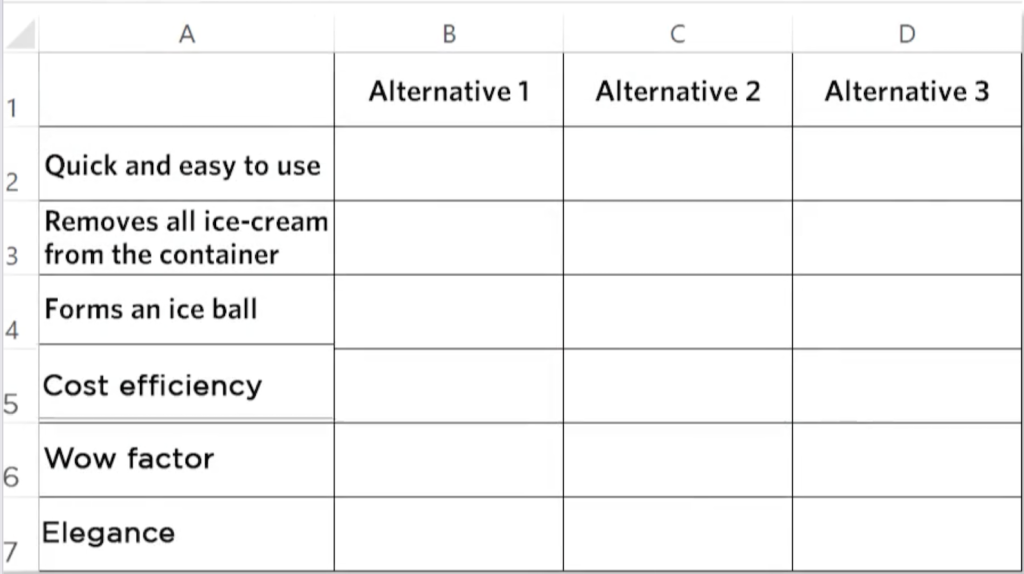
- What makes for a great solution concept?
- A concept is a preliminary description, e.g. sketch, storyboard, UI mockup
- Addresses needs of the customer
- Cost-efficient
- “Wow” factor (protectable, marketable)
- Aesthetics and elegance
- Digital goods
- Gives less importance to cost effectives
- Are often considered bundles of features rather than a single solution concept
- Offer unlimited flexibility in approach and as such need a thorough exploration of the solution landscape
- Concept Development – Basic Approach
- Brainstorm (not easy, requires openness, iterative)
- Narrow down
- Techniques to stimulate thinking
- Pull from insights
- Apply the decomposition principle (focus on one element of the job to be done at a time)
- Consider examples of distinctive approaches
- Consider analagous problems
- Set a numerical goal
- Harnessing the power of individuals and groups
- Independent parallel exploration is more effective than group approach (hybrid is best)
- Set a goal of 10 ideas per individual
- Have team members work alone, then convene in groups
- Idea generation and the quality of the best idea
- Selection Methods and Concept Selection Matrix
- Fill each cell with minus, zero, or plus
- Calculate net score of each alternative
- You might realize that concepts can be combined
Module 4
Quick Reference Guide
- Focusing on the sizzle for product success
- Elmer Wheeler “The sizzle has sold more steaks than the cow ever has. Although the cow is, of course, mighty important.”
- Products that have “sizzle:”
- Red Bull
- Pilot G2
- Apple products
- Beats by Dre
- Nintendo Switch
- Disambiguating design
- In the context of product management, design means:
- Solution concepts
- UI/UX
- Mechanical, electrical
- Form and function
- Product/brand identity
- Service architecture
- UI/UX Oversigiht Strategies
- Don’t mess with long established convention; often not worth educating user (e.g. minimize, maximize, exit buttons in corner of operating system windows)
- If deviating from norms is worth it, even after educating user, then commit (is value proposition of deviation high enough?)
- Accomodate multiple modes (especially in response to user feedback)
- Informed intuition by experienced designers gets you 90% of the way there; other 10% comes from data
- In the context of product management, design means:
- Product vision and PR FAQ
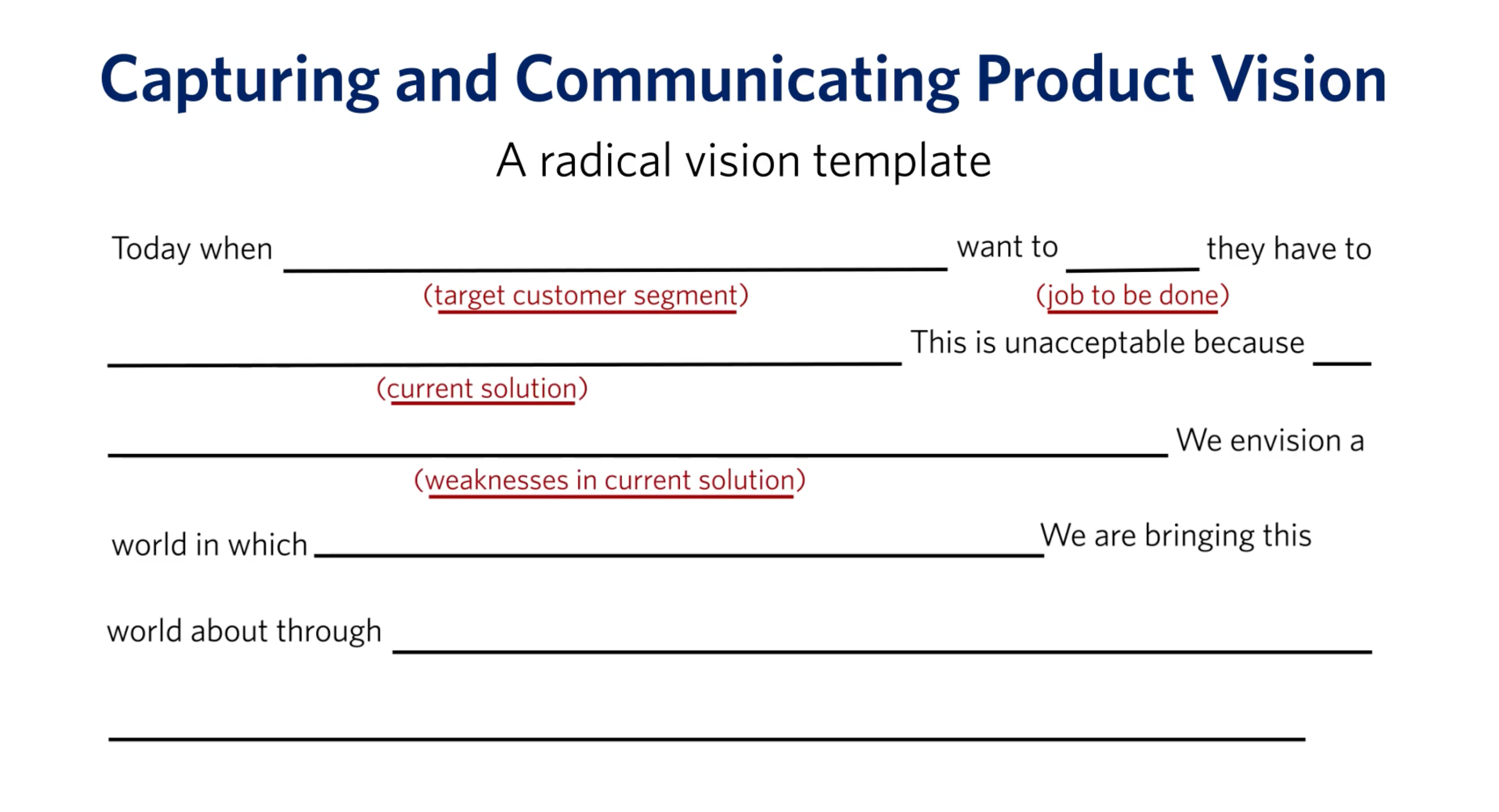
- A key role of the product manager is to communicate the product vision
- Template from Radhika Dutt:
- PR FAQ = press release/public relations frequently asked questions
- Basic format: PR FAQs for Product Documents
- Branding and Naming
- Pick a name that has it’s domain name available without hyphens or interruptions
- Communicates what the product does and wat the benefits are
- Caution: name evoking too a specific benefit proposition limits flexibility for future adaptations
- Evoke associated attributes
- Select easy-to-pronounce names
- Avoid spelling ambiguity
- Memorable
- Keep it short
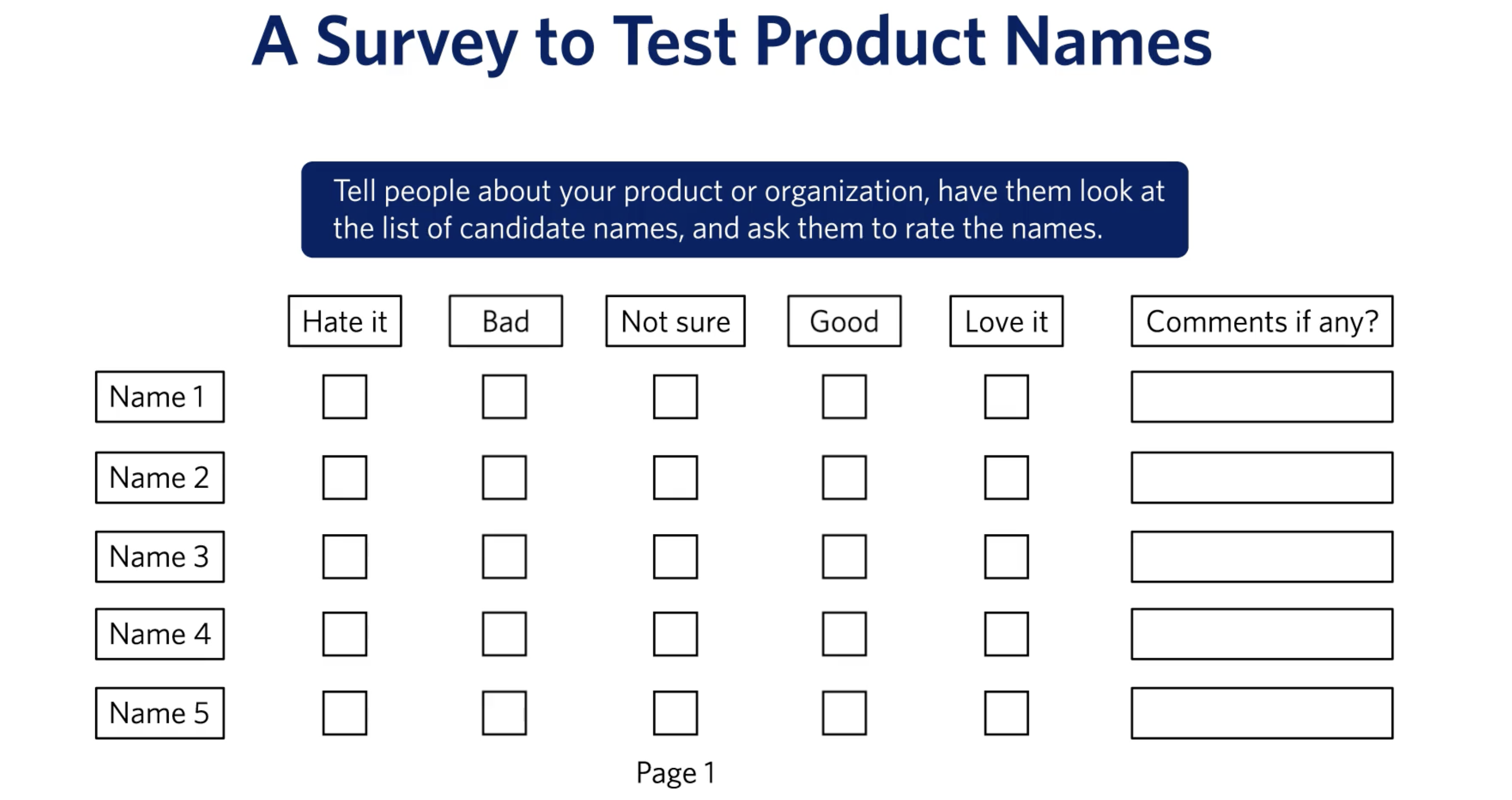
- The naming process
- Hire a consultant
- Run a naming tournament
- Once you have a shortlist, do some testing
- Industrial Design (for Hardware)
- The design activity associated with the aesthetic and human elements of physical goods
- Ulrich’s Lessonls Learned from Industrial Design
- High quality industrial design work is critical to consumer product success
- Long term cost of excellent industrial design is modest
- Some element of wow in the solution concept is an added advantage to design success
- Creating a beautiful product involves endless efforts and refinement of details
Module 5: Agile
Quick Reference Guide
- As a product leader, you should know costs and benefits of different approaches to development
- Introduction to Agile
- Agile Essentials
- Waterfall Process/Phase Gate Process
- Product Requirements (customers needs, target specs)
- System Level Design (concept and overall approach to solution)
- Detailed Design (resolves all designed details)
- Testing (internal and external)
- The Agile Process
- Scrum
- Overall job to be done is broken up into user stories
- All that matters is that the user able to achieve a goal
- PM is responsible for story prioritization and time estimates for each
- Story backlog/parking lot -> 2 week sprints over the year
- Sprint retrospective and iterative improvement
- Big tasks that take more than 1 sprint need to be broken down more
- Scrum
- Agile Story Points vs Hours: How to Calculate for Software Development
- Agile Estimation with the Bucket System
Module 6: Commercialization
Quick Reference Guide
Target costing
- Achieving financial sustainability: gross profit must exceed ongoing business operating costs
- Q(p – c) > F
- Q = quantity sold per unit time
- p = price per unit
- c = cost per unit
- F = fixed costs of operating the business per unit time
- Setting prices should be a deliberate exercise coordinated between the:
- business manager
- marketing and sales manager
- product manager
- Supply chain considerations for retailers
- Working backward from what customer pays:
- Retailer sells at 50% profit
- We target 25% gross profit when selling to retailer
- Gross margin = (price – cost) / price
- Gross margin calculated from perspective of the seller of product
- Factors that affect gross margin for retailers: volume, price, differentiation, distribution costs
- Working backward from what customer pays:
Customer lifetime value (LTV) and customer acquisition cost (CAC)
- Calculating LTV: total gross margin you expect to earn from a customer over time, discounted appropriately to reflect your cost of capital and the time value of money
- Calculating CAC: amount spent on marketing over a period of time divided by customers acquired in that time (usually not precise, average does fully convey cost to acquire more expensive/marginal customers)
Key performance indicators (KPIs) and dashboards
- What are we trying to do here?
- How can we measure how well we’re doing?
- Acquisition
- Product quality
- Customer satisfaction
- What are the goals? How do you measure them?
- Good KPIs are worth spending time deliberating
Growth
- Awareness
- Trial
- Repeat
Product Improvement
- Generate candidate improvements from user feedback
- Deduplicate, cluster, rationalize opportunities
- Estimate resource requirement
- Prioritize
- Implement using agile process
 Ishmam Ahmed